Following the brutal murder of George Floyd, and the subsequent global upheaval marked by protests and riots, my Facebook feed was awash with friends sharing information and personal reflections on systemic racism and police brutality in America. Nearly every one of these posts professed outrage of the murder, and support for the protests happening around the country. Many posts condemned and acknowledged the ever-present issues of systemic racism and police brutality that the protests sought to address. However, in the middle of this sea, a friend from Scotland posted something markedly different from everything appearing in my feed:
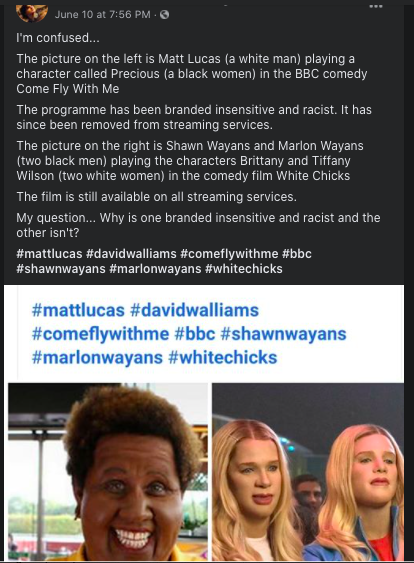
Matt Lucas is a white British comedian, best known for his work in Little Britain, which ran from 2000-2002 and satirises and poke fun of stereotypes of British people. White Chicks is a largely forgettable movie from 2004, in which two black cops (played by comedians Shawn and Marlon Wayans) use prosthetics and makeup to go undercover as white women.
The post asks a simple question, “why is one branded insensitive and racist and the other isn’t?” I was pleased to see a friend unabashedly re-post the above, as he seemed to genuinely ask a question about society. At the same time, I received an angry text from a fellow North American expatriate, incised that the post even existed: “they’re missing the point and they don’t understand the real issues. Black people are being murdered and need support and help. And here is another offended white guy ‘bUt wHaT abOuT WhiTe ChIckS?!?”
My North American friend is right to be angry about the post. It is a ridiculous comparison to make and the wrong thing to be concerned about when black people continue to be marginalized, oppressed and murdered in America. The post detracts from and ignores the huge issues being protested about in cities all over America, namely the murder of George Floyd, police brutality, and systemic racism. Black people being murdered with impunity by those in power is not new, nor is police brutality and the systemic racism that underpins the institutions of America. For reasons beyond me to unpick in this post, George Floyd’s murder at the hands of the group of quietly inhumane cops and the video evidence of it has sparked conversation, debate, and protests that are too loud and prominent for a majority of people and governments to ignore. Yet, the Facebook post ignores it wholeheartedly, instead focusing on a movie made nearly two decades ago and how it was wrong to pull Matt Luca’s episodes featuring him portraying a black woman from the air.
A slew of comments were thrown at his re-post, most affirming that racism is terrible, but that people were becoming “offended by everything, even comedy that is not racist.” My Scottish friend later told me that he regretted the post and wouldn’t have shared it if he had known it would illicit “heated comments.” But my Scottish friend is equally right to ask genuine questions about society that he doesn’t understand. We should welcome and encourage people when they have questions to ask about race and racism, as too often many (particularly white) people, will shut down and turn away from the discomfort of having to address and voice their questions, or the answers. Anger is useful and often-times warranted, yet it can serve to further alienate people, as opposed to help them understand something that perhaps they have never been exposed to or taught.
However, we should acknowledge that turning away from that discomfort or anger, as Lisa Dodson points out in When Race Becomes Real, is purely a privilege of white people. “Race in America is perilous ground. You walk into a minefield if you go there, and when you are white, you can choose not to.”
In the case of my Scottish friend, it was clear from speaking with him that he had never read or been taught about painful and racist legacy of blackface. White comedians who put on blackface as a comedy sketch, either maliciously or not, are playing into a deeper and long standing narrative of dehumanizing and “other-ing” black people. There is no long standing tradition of “white-facing,” no painful and racist history of white people being ridiculed en masse in popular culture. And if the impact of the movie White Chicks is anything to go by, nor would any negative consequences in policy, public life, or popular culture occur to white people if a black comedian put on “white-face.”
Dig a bit deeper, and I doubt his grade school curriculum included anything about systemic racism, or police brutality, or the school to prison pipeline, or the complex intersection of racism and history and social policies past and present. And I doubt the grade school curriculum in Scotland dug into how the institutions of America and former colonial powers (like Great Britain) are intrinsically racist, despite the abolition of slavery in the 19th century.
For many in Scotland and elsewhere, the lived experiences of black people are not a part of their education, their concern, or in their purview. This is either down to wilful ignorance, or the real reality of being a part of an education system and culture that is very homogenous, and not diverse. That must change. Being open and willing to talk, debate and discuss questions about racism- even seemingly ridiculous ones- is one step towards change.
The BBC’s actions of removing the blackface episodes caused the conversation for many people to shift from discussing the causes of the protests, to arguing about a trifle of a comedy show that is outdated and stale. A more constructive use of the BBC’s platform and power would be to highlight and promote black and ethnic minority artists and programmes more readily, and to show the myriad of BAME (Black, asian and minority ethnic) talent that can be overlooked in the face of Eurocentric bias.
Yet, despite the shift in direction of conversation with that Facebook post we can still learn from one another in these instances where it seems like the larger and more pertinent issues are being ignored, or talked over by useless noise. If we can’t feel comfortable asking questions and seeking answers, then it will be hard to read and acknowledge painful histories of humanity, or inhumanity. Without being open to starkly biased opinions and sometimes ridiculous questions, it is harder still to talk about and acknowledge the continued injustices and inhumanity occurring today.
————————————————————————————————————————————
Some deep dive resources to reflect upon:
Reni Eddo-Lodge “Why I’m no longer talking to white people about race”
Ta Nahesi Coates “The Case for Repatriations”
Howard Zinn A People’s History of the United States
Bernestine Singley, ed. When Race Becomes Real

 CLB Collins